
As water conservation becomes a global priority, dual-flush toilets have gained massive popularity in eco-conscious and regulatory-driven markets like the U.S. and Canada. However, simply offering a water-saving toilet isn’t enough for manufacturers aiming to export to North America. Compliance with a key performance standard—ASME A112.19.14—is essential.
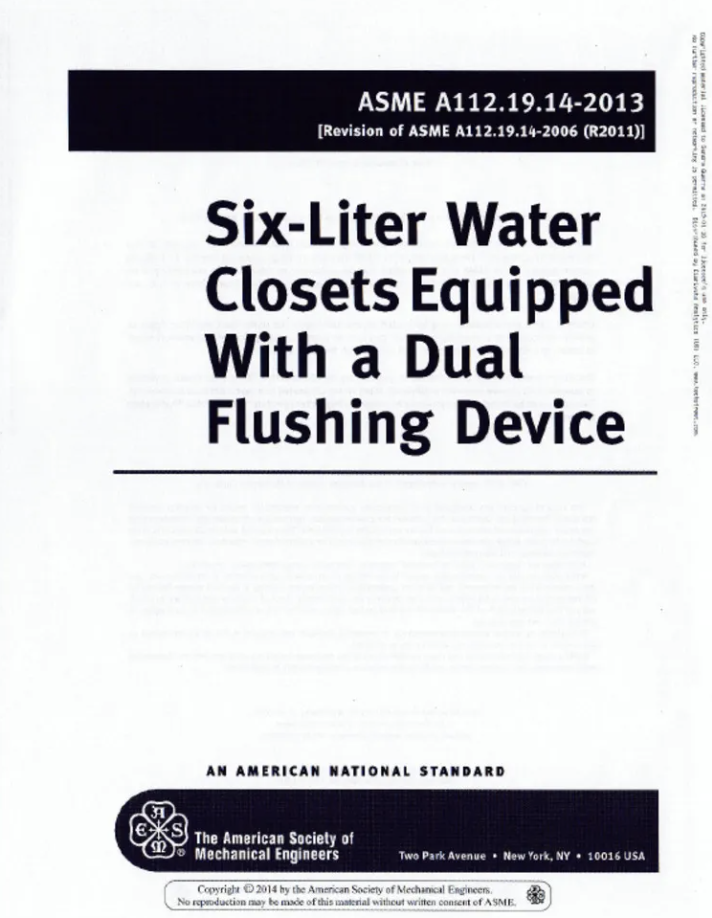
In this article, we’ll break down what ASME A112.19.14 is, how it regulates dual-flush toilets, and why it’s critical for brands, OEM clients, and manufacturers targeting the U.S. and Canadian markets.
What Is ASME A112.19.14?
ASME A112.19.14 is a product standard developed by the American Society of Mechanical Engineers (ASME) that specifically governs gravity-fed dual-flush toilets. It ensures that these fixtures are not only water-efficient but also meet essential performance and durability benchmarks.
Full Title:
ASME A112.19.14 – Six-Liter Water Closets Equipped with a Dual-Flush Device
This standard applies to:
- Gravity tank-type toilets
- Toilets with both full flush (typically 6.0 L / 1.6 gpf) and reduced flush (approximately 3.0 L / 0.8 gpf) options
- Units intended for residential, commercial, or institutional use in the U.S. and Canada
How ASME A112.19.14 Regulates Dual-Flush Toilets
The standard ensures dual-flush toilets provide effective waste removal, clear user guidance, and durability under repeated use—in both flush modes.
🔍 Key Performance Criteria
| Regulation Area | What the Standard Requires |
|---|---|
| Water Volume Limits | Full flush ≤ 6.0 liters (1.6 gallons); reduced flush approx. 3.0 L (0.8 gallons) |
| Flush Performance | Both flushes must remove waste effectively under lab-simulated conditions |
| User Interface Marking | Buttons or actuators must clearly indicate which is the full and reduced flush |
| Trapway Clearance | The trap must clear standardized test media in both flush modes |
| Tank Integrity Testing | Tanks must withstand pressure and loading without leaking or cracking |
| Endurance Testing | Toilets are subjected to thousands of flush cycles to prove long-term function |
Why ASME A112.19.14 Compliance Matters
Meeting this standard is not optional for exporters—it’s foundational to gaining access to North American plumbing markets.
✅ 1. Required by U.S. & Canadian Plumbing Codes
Many U.S. states and Canadian provinces reference ASME A112.19.14 in their Uniform Plumbing Code (UPC) and National Plumbing Code. Without compliance:
- Your toilets may be rejected by plumbing inspectors
- Your shipments could be stopped at customs
- Distributors or contractors may refuse to purchase uncertified products
✅ 2. Essential for cUPC Certification
cUPC certification—issued by IAPMO—is one of the most recognized plumbing product marks in North America.
ASME A112.19.14 is a core requirement for dual-flush toilet models to receive this mark.
If you’re exporting toilets to Amazon, Home Depot, Lowe’s, or project contractors, cUPC is often a non-negotiable prerequisite.
✅ 3. Compatible with Green Building Programs
ASME A112.19.14 supports broader environmental goals and aligns with:
- WaterSense labeling (for water efficiency)
- LEED & WELL building standards (for sustainable design projects)
Who Needs to Pay Attention to This Standard?
| Business Type | Why It Matters |
|---|---|
| Toilet Manufacturers | Product design must meet ASME requirements for export eligibility |
| OEM/ODM Brand Clients | Need assurance that their suppliers offer compliant, certifiable toilets |
| Importers & Contractors | Required to source only compliant models to pass inspections and sell legally |
| Export Managers & Traders | Increases buyer trust, shortens negotiation cycles, and prevents costly delays |
How to Verify ASME A112.19.14 Compliance
- Look for the cUPC Mark
- Request the ASME A112.19.14 Test Report from a recognized third-party lab
- Check the Testing Body – ensure the lab is accredited (e.g., IAPMO, CSA, Intertek, TÜV, SGS)
FAQs
❓ Is ASME A112.19.14 only for dual-flush toilets?
Yes, this standard applies specifically to gravity-type dual-flush water closets, not pressure-assisted or electronic toilets.
❓ If a toilet has WaterSense labeling, does it still need ASME compliance?
Absolutely. WaterSense ensures water efficiency, while ASME A112.19.14 ensures functional performance and durability—they complement each other.
❓ Can factories in China or abroad get certified?
Yes. Many international labs like IAPMO Shanghai, SGS, and Intertek offer ASME A112.19.14 testing and certification support for overseas manufacturers.
Conclusion: Certification Is the Gateway to the U.S. Market
ASME A112.19.14 isn’t just a technical detail—it’s a strategic export requirement for any manufacturer or brand entering the North American toilet market.
To compete successfully:
- Ensure your dual-flush toilet designs are tested to ASME A112.19.14
- Work with certification partners (IAPMO, cUPC) early in product development
- Provide buyers with valid documentation and testing reports
If you are an OEM/ODM client, brand owner, or importer looking for ASME A112.19.14 compliant dual-flush toilets, we can help you source and manufacture products that meet both performance and certification standards—ready for seamless entry into the U.S. and Canada.